OpenSpec
Overview
OpenSpec is a Spec-Driven Development (SDD) tool that emphasizes maintaining a single, unified specification document as the authoritative reference for a system's design and capabilities. Unlike traditional approaches that distribute specifications across multiple files, OpenSpec consolidates the current state of a system into one "living" specification that continuously evolves with the codebase.
This source of truth approach addresses persistent challenges in fragmented specification systems, where the overall system intent becomes hard to grasp holistically, feature interactions go undetected until implementation, and validating the complete specification against the live system becomes nearly impossible.
How OpenSpec Works
The OpenSpec workflow revolves around three key artifact types:
Change Specifications (Delta Specs)
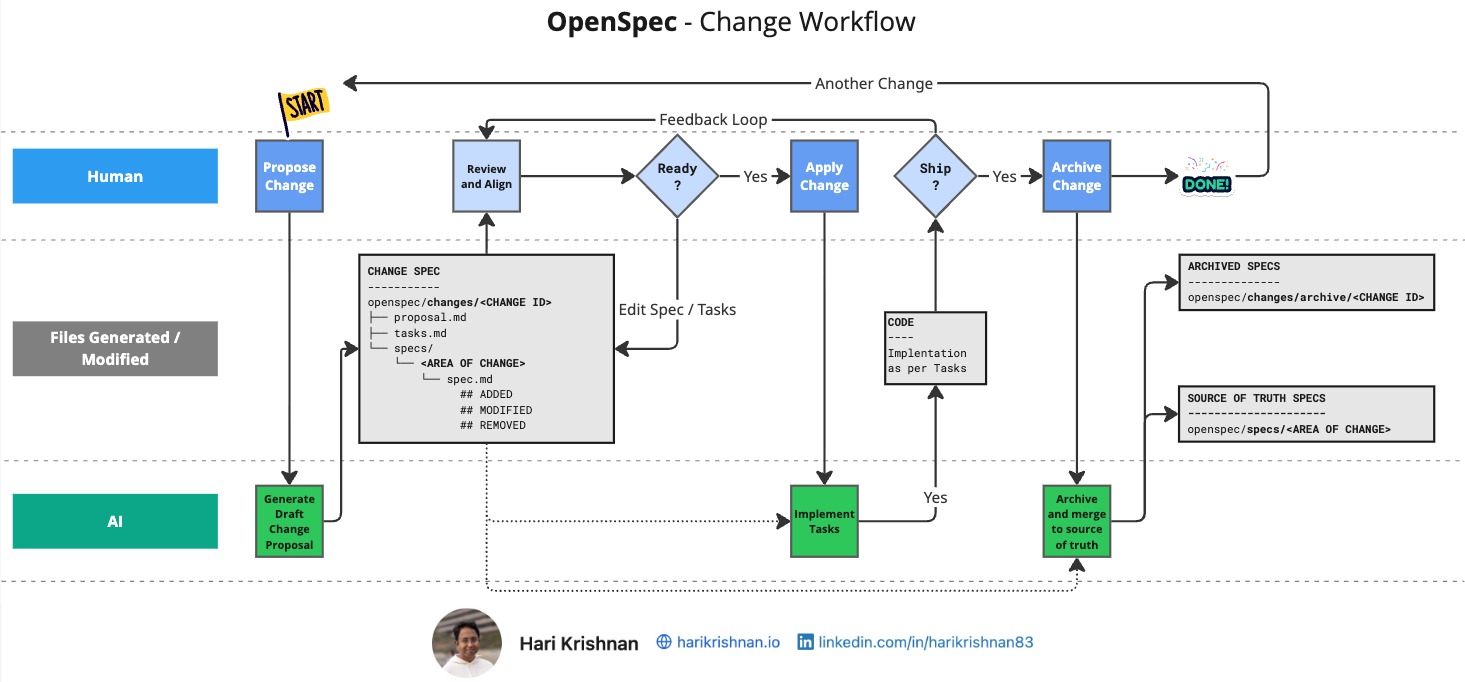
Delta specs represent proposed modifications. These interim documents mark sections as "ADDED," "MODIFIED," or "REMOVED," clearly communicating what has changed. This makes it easy for both humans and AI agents to understand exactly what's being proposed without needing to diff entire documents.
Source of Truth Specification
The primary specification represents the system's actual state. All delta changes eventually merge into this single document during the archive phase, creating a definitive reference that stakeholders can consult. This ensures everyone is working from the same understanding of what the system does.
Archived Specifications
Archived specs preserve the historical lineage of earlier delta specs once they've been incorporated into the source of truth, maintaining an audit trail of evolution. This creates accountability and allows teams to understand how and why decisions were made.
Video Tutorials
Learn OpenSpec workflows and best practices through our video tutorials. The playlist covers everything from getting started to advanced integration patterns.
Workflow Diagrams
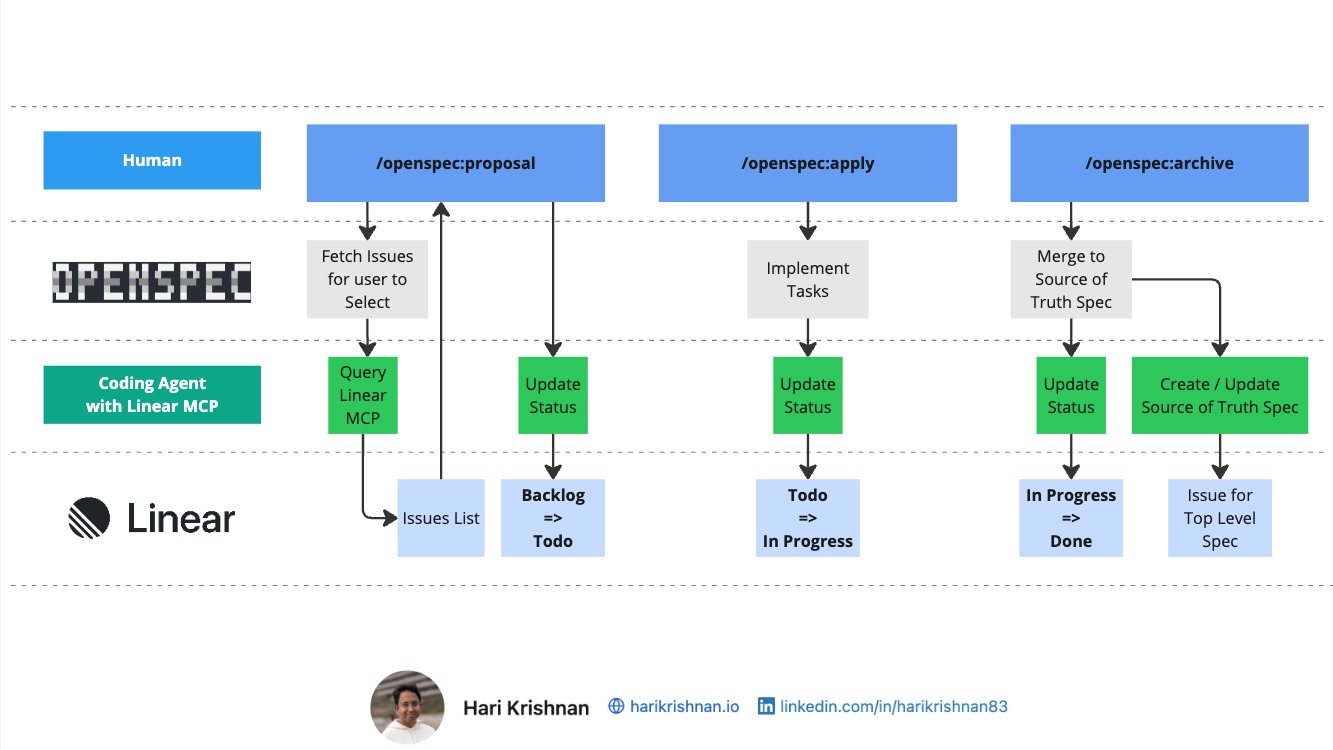
Visual guides to understanding OpenSpec workflows and integration patterns.
Blog Posts
In-depth articles covering OpenSpec concepts, workflows, and integration patterns.
-
OpenSpec Custom Schemas
— Custom schemas in OpenSpec let you tailor spec-driven workflows to your domain. Covers minimalist and event-driven schema examples.
-
OpenSpec 1.0 Release
— Release update for OpenSpec 1.0 with the walkthrough video and workflow highlights.
-
Linear MCP + OpenSpec: A Spec-Driven Development Workflow
— A practical walkthrough of using Linear MCP with OpenSpec to keep the backlog in sync. Covers roles, handoffs, and separating business use cases (What) from technical implementation (How).
-
Spec-Driven Development with OpenSpec: Source of Truth Specification
— Comprehensive guide explaining the OpenSpec workflow and source of truth specification concept. The foundational article for understanding OpenSpec.
Key Benefits
- Spec-Anchored Alignment: By maintaining a unified specification, OpenSpec enables validation at any point against the current, authoritative specification. This contrasts with fragmented approaches that typically remain in "Spec-First" territory, where specifications guide initial design but gradually become unreliable as the implementation diverges.
- Faster Iteration Cycles: The streamlined workflow supports better flow states and quicker implementation cycles, especially when working with AI coding agents.
- Brownfield Support: Natural support for brownfield and legacy projects—you can capture existing system states without requiring complete rewrites.
- Feature Interaction Detection: Understanding unintended interactions between features becomes easier when everything is in one specification.
- Continuous Validation: Confidence that specifications remain synchronized with implementation through the source of truth model.
When to Use OpenSpec
OpenSpec excels for teams practicing incremental, spec-driven development who need confidence that specifications remain synchronized with implementation. It works particularly well for:
- Projects requiring continuous validation between specification and code
- Brownfield or legacy system modernization efforts
- Teams that value quick iteration and frequent specification updates
- Systems where understanding unintended interactions between features is critical
- Development workflows involving AI coding agents
The tool assumes comfort with AI-assisted development and maintaining disciplined change practices through small, focused modifications.
Resources
-
OpenSpec GitHub Repository
Official OpenSpec repository with documentation, examples, and CLI tool.
-
OpenSpec GitHub Discussion
Community discussion and feedback on OpenSpec workflows and best practices.